Add a field to one of your Webflow collections

Tutorial
3 min
Published on Sep 28, 2022
Updated on
Webflow logo with Webflow CMS collection icon
Use AI to summarize this article
Key points

You can compare your Webflow CMS collections with the back-office of your Webflow site. Its requirements may evolve from its initial development.

Need to add a new field to your Webflow back-office?

Discover in this tutorial how to add a new field (item) to your Webflow CMS from the designer mode.

The tutorial in a few steps

1. Open the CMS Collection panel
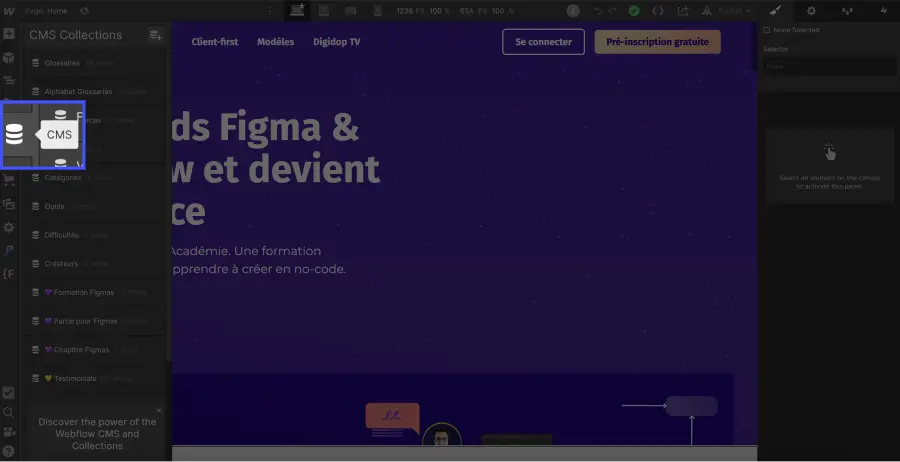
CMS button on Webflow designer

2. Click on ⚙️ of the target collection
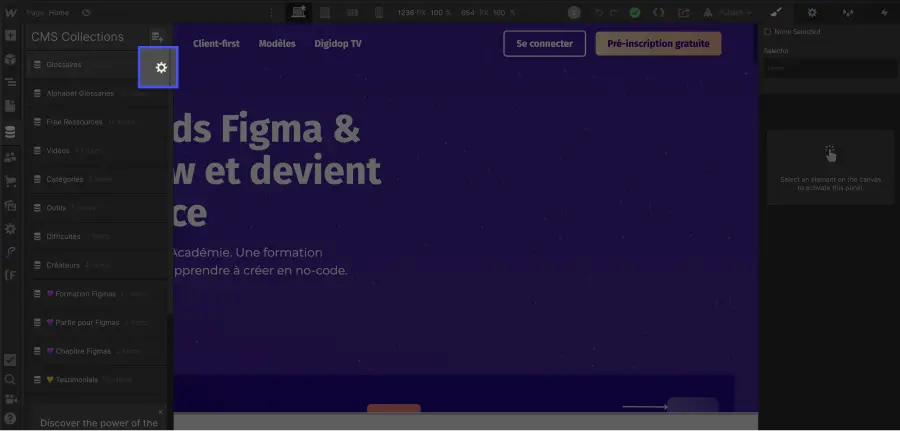
Open the settings of a Webflow collection

3. Click the + Add new field button
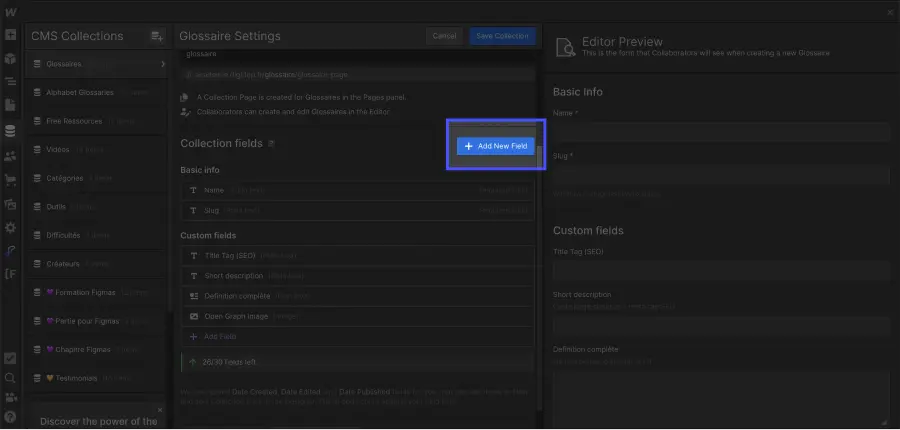
Adding a new Webflow CMS field

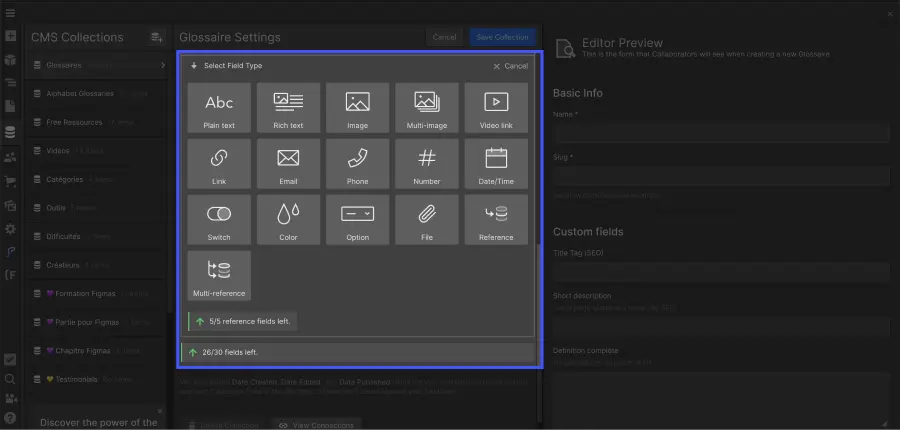
4. Choose your field type

Different available fields in the Webflow CMS

There are various types of CMS fields in Webflow.

To learn more about all the fields, read this article.

5. Fill in the field and Save
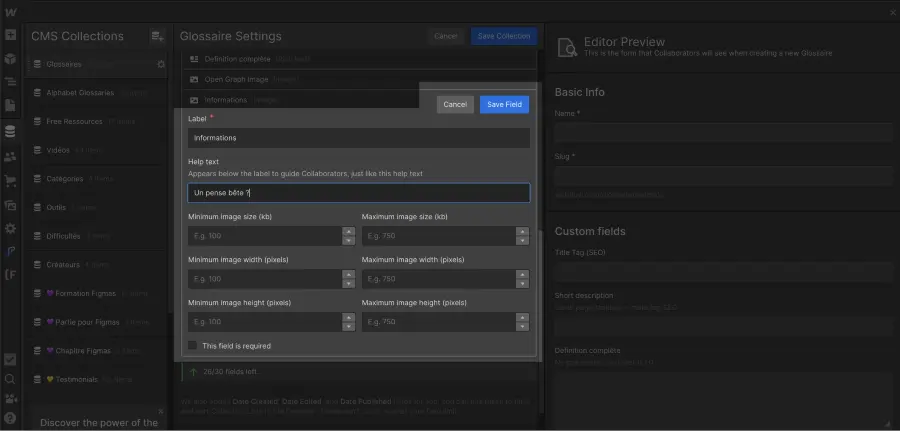
Add a field on Webflow

Last step!

Fill in the field with the name you wish to give it. You can add a note in the "help text" as a reminder.

This "help text" field is very useful if you are building collections for a team. It helps everyone understand how to use this field on the site.

Bonus: Remove an unused field

To delete an unused field:

  1. Hover over the field in question
  2. Click the ⚙️ icon to the right of its name
  3. Click the 🗑 "Delete Field" icon
Florian Bodelot
Florian Bodelot
Co-founder

Suggested articles

Minimal dark landing page displaying “The Digidop Company” with the tagline “Build. Scale. Inspire.” and the Digidop and Vydera logos at the bottom.
News
Digidop

A new step for Digidop: The Digidop Company and the launch of Vydera

A new step for Digidop: The Digidop Company and the launch of Vydera
Screenshot of a Google search results page displaying an AI-generated response for the query “does blog have a sense in 2026?”.
Documentation
SEO

What is the future of blogs on corporate websites?

What is the future of blogs on corporate websites?
Abstract illustration representing the concept of server-side tracking
Documentation
Development

Understanding Server-Side Tracking Made Simple

Understanding Server-Side Tracking Made Simple

Want to turn your website into your most valuable asset?

Contact us today