A prospect who discovers your company reads your reviews before getting in touch. More and more often, they don't even read them: they ask ChatGPT or Gemini, which summarizes them.
In this article, we cover what customer reviews do for a website in 2026: how much they weigh in Google and in AI answers, which platforms to choose and what they cost, the rules on fake reviews (now stricter in the US, the UK and the EU), and how to display reviews on a Webflow site without losing their value.
Originally published in 2021, fully updated on October 6, 2026.
What reviews do for a website
Two studies come up again and again. They're solid, as long as you look at what they measure.
BrightLocal's Local Consumer Review Survey 2026, published on February 11, 2026, surveyed 1,002 US consumers about local businesses:
- 97% read reviews for local businesses;
- 74% look for reviews written in the last three months;
- 47% won't use a business with fewer than 20 reviews;
- 89% expect business owners to respond to reviews.
Northwestern University's Spiegel Research Center measured the effect of reviews on retail sites in 2017: a product with five reviews has a 270% higher purchase likelihood than a product with none. The same study found that purchase likelihood peaks at ratings between 4.0 and 4.7, then drops as ratings approach 5.0. A perfect score looks less credible.
These numbers come from US local businesses and e-commerce. For a B2B website, the same logic applies at a smaller scale: in our view, a few detailed, recent reviews on a platform your buyers know are worth more than a five-star banner with no names or dates.
Customer reviews and SEO: what Google actually says
In Google Maps and local search
Google ranks local results on three factors: relevance, distance and prominence, meaning how well known a business is. In its Google Business Profile help, Google places review count and positive ratings under prominence, and notes that replying to reviews helps a listing stand out.
A side note: Google My Business is now called Google Business Profile. It's free.
Stars in search results
Google can show stars under a result when the page carries Review or AggregateRating markup. Two rules in Google's review snippet documentation (updated on September 8, 2026) rule out most company websites:
- Self-serving reviews don't get stars. If the entity being reviewed controls the reviews about itself, its pages marked up as
LocalBusinessorOrganizationaren't eligible. The testimonials on your homepage won't earn stars in Google. - No aggregation. You can't copy your Trustpilot or Google rating into your markup: ratings must come directly from the page's users.
Markup is still useful on a product page (Product) that collects its own reviews, or for software (SoftwareApplication). For an agency, a firm or a B2B vendor marking up testimonials as Organization, there won't be any stars. We cover these markup types in our structured data guide.
Review text on your pages
A review published as text on a page is part of that page's content. It brings in your customers' words, which aren't always yours, and often answers a prospect's objections better than a sales pitch. Google hasn't published any rule that makes reviews a ranking factor on their own: we treat them as useful content and don't expect miracles.
Customer reviews and AI visibility
Many of the searches that lead to this article ask the same thing: do reviews influence what ChatGPT, Gemini or Google AI Mode say about a brand? The vendors document part of the answer.
- OpenAI says ChatGPT can show model-generated review summaries in its shopping results, based on reviews from public websites, and that those reviews aren't verified by OpenAI (OpenAI Help, Shopping with ChatGPT Search).
- Google uses Gemini to summarize place reviews in Google Maps, and answers questions about a place from its reviews, photos and the web (Google blog, October 31, 2024).
- On the consumer side, BrightLocal found that 45% of the US consumers surveyed used ChatGPT or another generative AI tool for local recommendations, up from 6% the year before, and that 82% read AI-generated review summaries.
What nobody knows is how many reviews it takes for an AI to start recommending a brand. No vendor publishes a threshold. The numbers going around ("100 reviews", "40% more mentions") don't trace back to any study you can check. The previous version of this article quoted some of them; we've removed them.
In practice, we draw three conclusions:
- Your reviews matter first where your customers leave them: Google, Trustpilot, G2, your industry's directories. That's where the engines look for them.
- On your own site, publish testimonials as HTML text. A Vercel analysis published in December 2024 found that OpenAI's, Anthropic's and Perplexity's crawlers didn't execute JavaScript. A JavaScript widget may stay invisible to them, while Gemini, which relies on Googlebot's infrastructure, can read it.
- A detailed review (the context, the problem, the result) gives an AI more to summarize than a string of "great, thanks".
To go further on visibility in answer engines, read our GEO guide.
Customer review platforms: which one to choose in 2026
Prices checked on October 6, 2026, on the official pages.
| Platform | Best for | Price | Good to know |
|---|---|---|---|
| Google Business Profile | any business that serves customers at a location or in an area | free | reviews shown in Google Maps and Search; strict fake review policy |
| Trustpilot | e-commerce, B2C and B2B services | free up to 50 invitations a month; Starter from $99, Plus from $319, Premium from $799 a month per domain, billed annually | 12-month contracts; Starter only for new small businesses (up to $5M revenue); Enterprise on quote |
| Avis Vérifiés / Verified Reviews (Skeepers) | e-commerce and retail, strong in France | no public pricing, on quote | certified by AFNOR since 2014, now compliant with the NF ISO 20488 standard and the NF522 framework; reviews tied to a purchase |
| G2 | B2B software and services | free profile; paid marketing plans | G2 announced on January 29, 2026 that it is acquiring Capterra, Software Advice and GetApp from Gartner |
| Capterra | software | free listing; paid pay-per-click visibility, bids from $2 | buyers compare several tools in the same category |
How to choose, depending on your business:
- You have a location or a service area: start with Google Business Profile. It's free, and it's where your customers look for you.
- You sell online: pick a solution that ties each review to an order (Trustpilot, Verified Reviews) so you can show verified product reviews on your product pages.
- You sell software: G2 and Capterra, where your buyers compare tools.
- You sell B2B services: your Google listing, plus one platform your buyers actually check. One complete profile beats five empty ones.
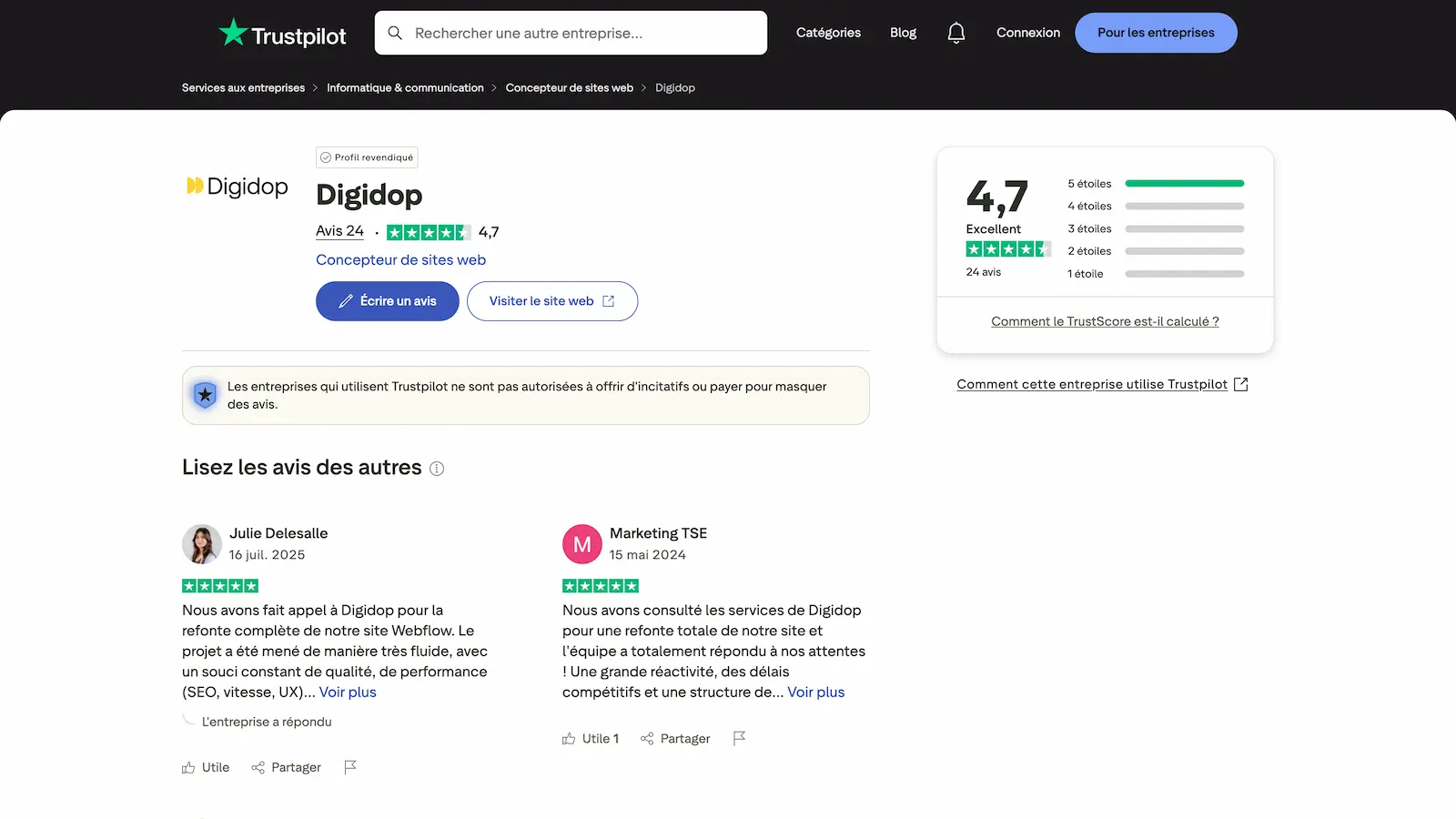
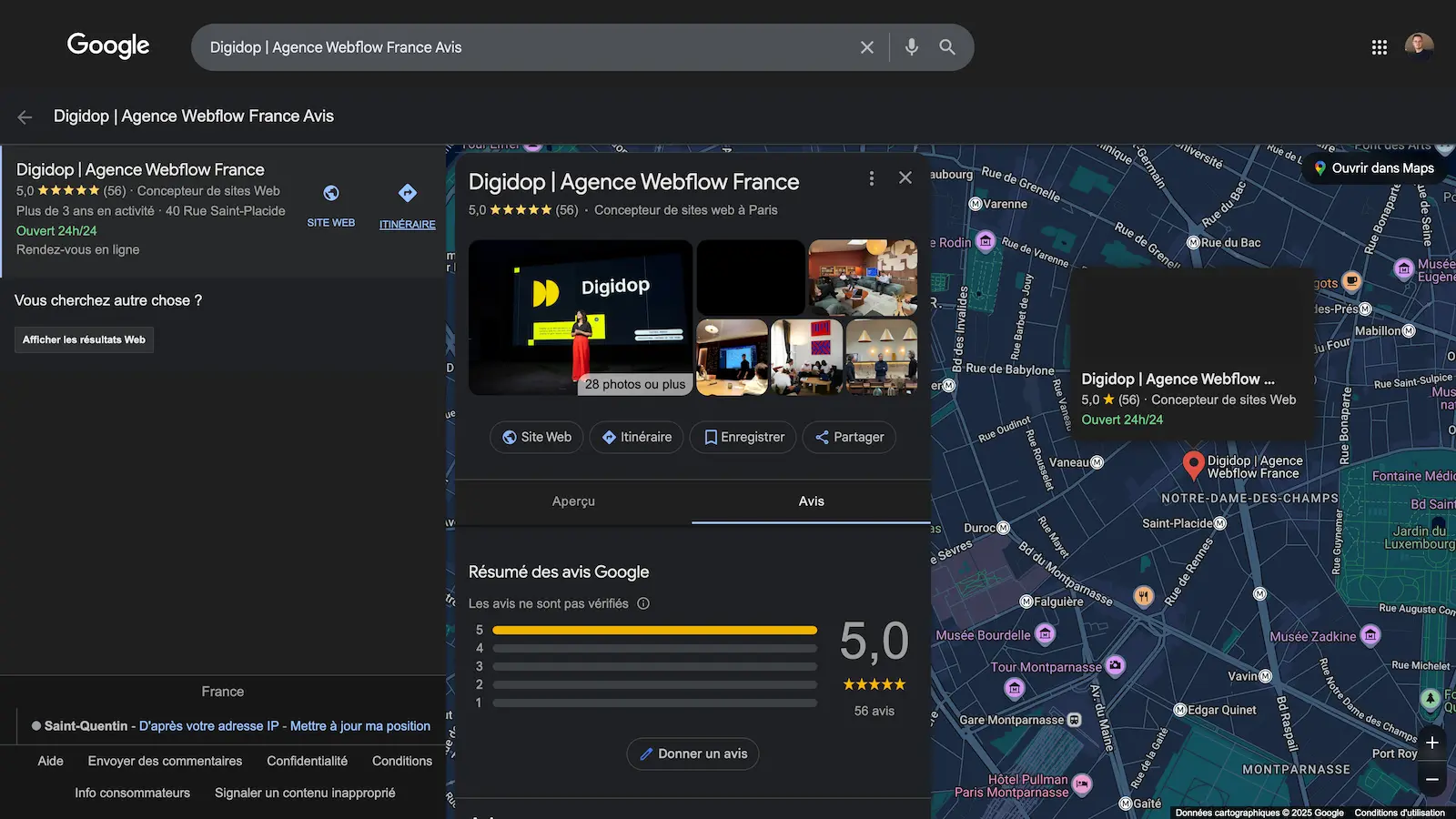
Digidop's own profiles, on Trustpilot and on Google:
Fake reviews: what the law says in 2026
In the United States
The FTC's Rule on the Use of Consumer Reviews and Testimonials (16 CFR Part 465) has been in effect since October 21, 2024. It bans reviews attributed to people who don't exist or never used the product, buying such reviews, incentives conditioned on a positive (or negative) review, reviews by officers or employees that don't disclose their connection, threats to get a negative review removed, and presenting a review page as complete when bad reviews were filtered out. In December 2025, the FTC sent warning letters to ten companies and reminded them that each violation can cost up to $53,088 in civil penalties, a cap still in force in October 2026 (16 CFR 1.98).
In the United Kingdom
Since April 6, 2025, the Digital Markets, Competition and Consumers Act 2024 explicitly bans posting or commissioning fake reviews, and publishing incentivised reviews without saying so. The CMA can now fine companies up to 10% of their global turnover.
In the European Union and France
The EU "Omnibus" directive (Directive (EU) 2019/2161), applicable since May 28, 2022, regulates consumer reviews:
- if you publish reviews, you must state whether and how you check that they come from customers who actually bought or used the product;
- you can't claim reviews come from real customers without taking reasonable steps to check;
- you can't post or commission fake reviews, or misrepresent existing reviews to promote a product.
In France, these rules sit in the Consumer Code (articles L121-4 and L111-7-2), and the consumer protection authority, the DGCCRF, also bans editing, deleting or hiding negative reviews. Fake reviews are a criminal offense punishable by two years in prison and a €300,000 fine, which can rise to 10% of average annual turnover.
On Google
Google's prohibited content policy bans offering anything (payment, discounts, free goods or services) in exchange for a review, discouraging negative reviews, asking only happy customers, and having employees review the business. When Google finds a violation, it can block new reviews, unpublish existing ones for a time, or show a warning on the listing. In 2025, Google says it blocked or removed more than 292 million policy-violating reviews (Google blog, April 16, 2026).
Collecting reviews without breaking the rules
- Ask all your customers, not only the happiest ones. Screening who gets asked is against Google's policy.
- Don't offer anything in return. The FTC bans incentives tied to the sentiment of the review, the UK requires them to be disclosed, but Google bans any incentive, even with no condition on the rating. A discount for a Google review puts your listing at risk.
- Ask at the right moment: after delivery, launch or the end of a project, while the experience is still fresh.
- Make it easy. Google recommends sending a direct link to your listing or a QR code (Google help).
- Reply to every review, negative ones included. In the BrightLocal survey, 42% of consumers say they're unlikely to use a business that never replies. In our view, a calm, specific answer to a bad review reassures more than a profile with no criticism at all.
- No reviews from employees, relatives or partners, even sincere ones.
Displaying customer reviews on your website (Webflow, e-commerce)
Three options, depending on what you need.
The platform's widget
Trustpilot provides widgets (TrustBoxes): a script goes in Site settings, then a Code Embed element goes where the widget should appear. The Code Embed element requires a paid Site plan, or a Core, Growth, Agency or Freelancer Workspace (Webflow Help). The upside: reviews verified by a third party, always up to date. The downside: the widget loads with JavaScript, offers little styling control, and some AI crawlers won't read it.
A CMS collection of testimonials
Create a collection with name, role, company, review text, date and a link to the original review. Reviews are published as HTML, in your design, and reusable on any page (service pages, case studies, pricing). The downside: updates are manual, and in the EU you have to say whether and how you verify these reviews. Our Webflow CMS article explains how to structure this kind of collection.
Both
Publish a few CMS testimonials on your key pages, with a link to your full profile. If you pick your best reviews, present them as a selection: passing them off as all your reviews is what the FTC rule and the Omnibus directive ban.
On markup, there's no point adding an AggregateRating copied from Trustpilot or Google to your company pages: it isn't allowed and won't earn stars. On an e-commerce site, Product markup with your own reviews is still eligible.
{{custom-blog-cta}}
Our take
Reviews have gained value with answer engines, but not the way 2025 articles promised, this one included. There's no magic number of reviews that triggers a ChatGPT recommendation, and stars in Google are out of reach for most company websites.
What works is less spectacular. Real reviews, requested from all your customers, on the platforms your buyers and the engines check. A reply to every review, bad ones included. And a website that publishes its testimonials in plain text, with a name, a date and a link to the source. The risk, meanwhile, has gone up sharply: a discount for a review, common practice a few years ago, can now get a Google listing blocked and breaks the law in the US, the UK and the EU alike.
Frequently asked questions
Do customer reviews affect SEO?
Yes for local search: Google counts review count and positive ratings toward a Google Business Profile's prominence. On your own site, review text is content like any other. Stars in search results are only possible for certain page types, such as product pages that collect their own reviews.
How do customer reviews affect whether AI recommends my brand?
ChatGPT can summarize reviews from public websites, and Google Maps summarizes reviews with Gemini. Reviews are part of what these tools read. No vendor, however, publishes how much they weigh in a recommendation.
How many customer reviews do I need before AI systems recommend my brand?
Nobody knows: no engine publishes a threshold. On the consumer side, 47% of the US consumers BrightLocal surveyed in 2026 won't use a business with fewer than 20 reviews, and 74% look for reviews from the last three months. Aim for a steady flow rather than a big number.
Can I get Google stars for reviews on my own website?
Not for a company page. Google excludes reviews a business controls about itself (LocalBusiness and Organization types) and bans ratings copied from another site. A product page that collects its own reviews is still eligible.
Which customer review platform should I choose?
Google Business Profile for any business with local customers, since it's free. Trustpilot or Verified Reviews for an e-commerce site. G2 and Capterra for software. For B2B services, a well-kept Google listing plus one platform your buyers check is often enough.
Can I offer a discount in exchange for a review?
Not on Google: any incentive is banned, even with no condition on the rating. In the US, the FTC bans incentives conditioned on a positive or negative review; in the UK, incentivised reviews must be disclosed. The simplest rule is to offer nothing.
Do product reviews increase visibility?
In local search, yes: Google counts review count and positive ratings toward a listing's prominence. In regular search, product pages that collect their own reviews can show stars with Product markup, which makes the result stand out. In AI answers, ChatGPT and Gemini summarize reviews published on public websites, so reviews on well-known platforms give them material to work with. No engine publishes how much this weighs.
What are the penalties for fake reviews?
In the US, up to $53,088 per violation. In the UK, up to 10% of global turnover. In France, up to two years in prison and a €300,000 fine, which can rise to 10% of average annual turnover. On Google, blocked reviews and a visible warning on the listing.
{{global-cta="/services/agence-webflow"}}