Webflow has just announced another pricing update. But this time, it’s more structural than a simple pricing “change.” It’s another step forward in its upmarket strategy.
Pricing changes
Until May 2026, Webflow offered 4 different pricing systems for its Site Plans:
- Free Starter: ideal for testing, prototyping, and discovering Webflow with core features and Webflow AI.
- Basic: $14/month: designed for landing pages, portfolios, showcase websites, or MVPs without a CMS
- CMS: $23/month: built for blogs and SEO-driven websites with dynamic content management through the CMS.
- Business: $39/month: designed for high-traffic marketing websites with more advanced CMS needs.
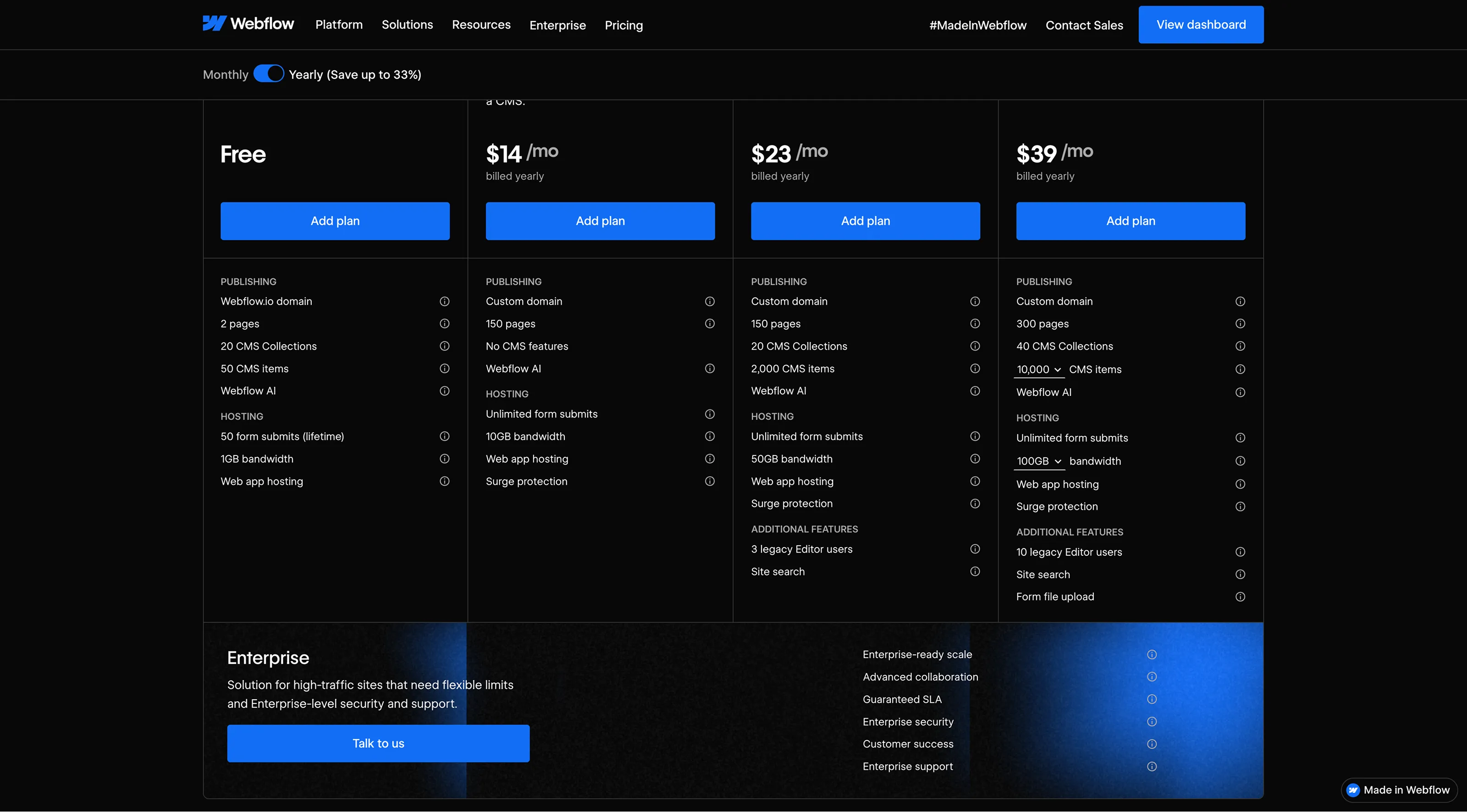
Each pricing tier had its own features and offered the possibility, through add-ons, to unlock additional features. Then came the Enterprise plan, available only through custom pricing, which includes the platform’s most advanced capabilities.
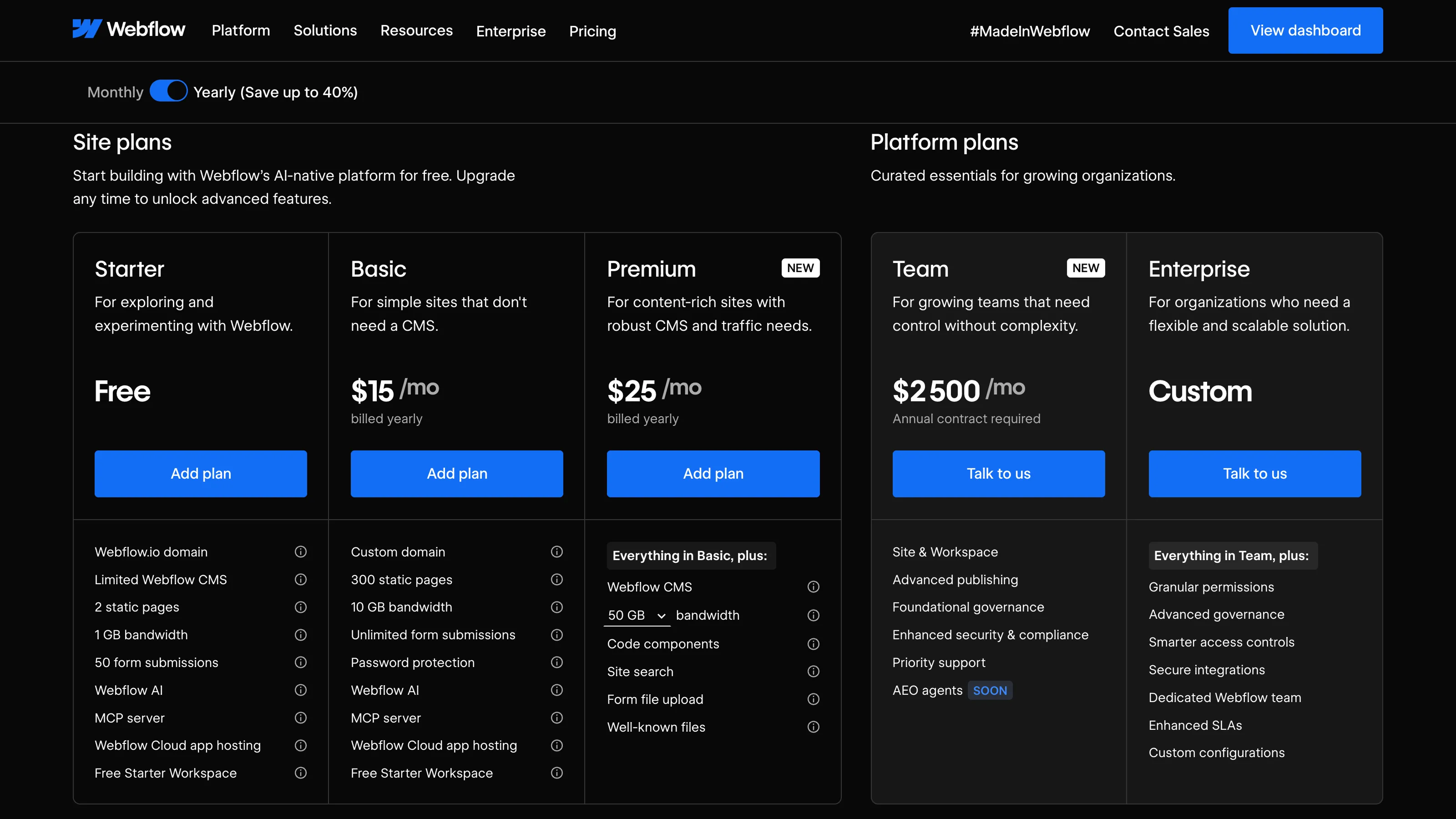
But starting today, the available packages are changing:
- The former CMS and Business plans are now merged into a single plan: Premium. ($25/mo)
- The Basic plan is also seeing a slight price increase. (14 to 15$/mo)
- And Webflow is introducing a new Team plan, a new intermediate layer between self-serve and Enterprise. ($2 500/mo)
But that’s not all.
Webflow is also integrating AI more deeply into its product and aligning its usage model with current market practices. A new AI credits system is being introduced, with some features consuming AI credits while others remain included in subscriptions. (Example: Localization)
Explore all pricing in this article →
Why this change?
The web is evolving very quickly, and AI is becoming more and more central across all platforms. By accelerating in this direction, Webflow is looking to simplify its offerings by grouping certain plans together while reinforcing a usage-based pricing logic through add-ons.
The whole update is positioned as a pricing simplification: fewer complex choices, better offer readability, and a new Team-oriented approach that better aligns with the needs of companies that have outgrown self-serve plans without yet requiring a full Enterprise setup.
And if you want to learn more about the platform’s motivations, you can read the announcement article published by Webflow on May 13.
Our opinion
When you take a step back and think about it, I believe this is a smart move from Webflow.
While many AI builders will probably absorb the market for small websites and simple landing pages, Webflow continues moving toward more advanced needs: collaboration, scale, governance, performance, and multi-team management.
For several years now, Webflow has been trying to move upmarket. And from a “psychological” perspective, the pricing publicly displayed on the website through self-serve plans was relatively inexpensive compared to everything the all-in-one platform now offers. In the eyes of some companies, that could sometimes make the platform feel a bit “cheap.”
Today, with simpler pricing and the ability to quickly preview available packages and add-ons, the positioning immediately feels more enterprise-oriented. Webflow is no longer afraid to display pricing that reflects the value delivered. It’s a premium and modular pricing strategy that strongly resembles the approach of major industry players like HubSpot or Semrush.
Additional questions
What impact will this have on pricing for high-traffic Business websites?
Business subscriptions with significant traffic will need to move to the Premium plan with additional bandwidth add-ons. Reaching 100GB results in an annualized monthly price of $45, which remains relatively similar to previous pricing.
What impact will this have on pricing for CMS websites that do not need these new features?
In some cases, users of the former CMS plan may see a slight price increase, even without using all the new features included in the Premium plan. In exchange, Webflow is also increasing several default limits, such as the number of CMS items, CMS Collections, and certain features that were previously only available through add-ons.
Are AI credits mandatory?
No. Many AI features on the platform already work with the credits included in subscriptions. And thanks to the MCP Bridge App, you can also operate your website with AI using your own external LLM credits (Claude, etc.).


.webp)