You hear everything about structured data: "SEO's secret weapon", "a must to get cited by ChatGPT", or the opposite, "useless since Google dropped FAQ snippets". All three are wrong, and the rules have changed a lot since 2023.
In this article, we go back to the official sources: what structured data does for Google, which rich results still exist in October 2026, what we really know about its role in AI search, and how to add it in Webflow.
Originally published in 2022, fully updated on October 6, 2026.
Structured data in two minutes
Structured data is markup added to a page's code to tell search engines explicitly what the page contains: an article, its author and date; a company, its logo and address; a product, its price and availability.
The vocabulary is Schema.org, launched in 2011 by Google, Microsoft, Yahoo and Yandex and still maintained (version 30.1 shipped on September 16, 2026). There are three formats: JSON-LD, Microdata and RDFa. Google accepts all three but recommends JSON-LD in most cases: the markup sits in a <script> block separate from the text, so you can maintain it without touching the design.
Here is what the markup for a blog post looks like:
<script type="application/ld+json">
{
  "@context": "https://schema.org",
  "@type": "BlogPosting",
  "headline": "Structured Data for SEO and GEO in 2026",
  "datePublished": "2022-08-30",
  "dateModified": "2026-10-06",
  "author": { "@type": "Person", "name": "First Last" },
  "publisher": {
    "@type": "Organization",
    "name": "Your company",
    "logo": { "@type": "ImageObject", "url": "https://www.example.com/logo.png" }
  },
  "image": "https://www.example.com/post-image.webp"
}
</script>
Terms like @type, headline and author come from Schema.org. The search engine no longer has to guess where the title is, who wrote the page and when: it's declared.
What structured data does for SEO
It makes pages eligible for rich results
That's its main use in Google. A rich result shows more than a blue link: star ratings, a price, an event date, breadcrumbs, a video thumbnail. Google's introduction page still cites Rotten Tomatoes, which measured a 25% higher click-through rate on marked-up pages than on the others (Google Search Central).
Two caveats. Valid markup makes a page eligible, it doesn't guarantee the display: Google says so plainly in its general guidelines. And the markup must describe what visitors can see: marking up hidden or misleading content can lead to a manual action.
It doesn't boost rankings
Google doesn't present structured data as a ranking factor, and its own announcements say as much: when it retires a rich result, it notes the change "won't affect how pages are ranked" (June 2025). A structured data manual action removes rich result eligibility without affecting how the page ranks.
So the SEO benefit comes through clicks (a rich result catches the eye) and through understanding: Google also uses this markup to work out who publishes a page, who wrote it and what the company logo is.
Google rich results in 2026: what's gone, what's left
This is what has changed most since the first version of this article. Google has retired a series of rich results to "simplify" its results page:
| Rich result | Status in October 2026 | Since | Source |
|---|---|---|---|
FAQ (FAQPage) | retired | limited to authoritative government and health sites in August 2023, no longer shown at all since May 7, 2026, documentation removed in June 2026 | Google, 2023 · changelog |
How-to (HowTo) | retired | September 13, 2023 | |
| Sitelinks search box | retired | November 21, 2024 | |
| Course Info, ClaimReview, Estimated Salary, Learning Video, Special Announcement, Vehicle Listing | retired | announced June 12, 2025, removed from Search Console in September 2025 | |
| Practice problem, Dataset (in Google Search) | retired | announced November 5, 2025 | changelog |
Still listed in the official gallery, among others: Article, Breadcrumb, Organization, Local Business, Product, Review snippet, Event, Video, Profile Page, Discussion Forum, Software App, Recipe, Job Posting.
Two restrictions often catch B2B sites out:
- Reviews of your own business won't earn stars. Google only accepts reviews of an
OrganizationorLocalBusinesson sites that collect reviews about other businesses (Review snippet). - Webinars aren't eligible for the Event rich result: Google requires events to take place at a physical location (Event).
Should you remove existing FAQ or HowTo markup? Google says there's no need: unused markup causes no problems, it simply has no visible effect (Google, 2023).
Structured data and GEO: what we actually know
This is the question most readers of this article are asking: does structured data help you get cited by ChatGPT, Gemini, Perplexity or AI Mode? Each vendor has taken a position, with nuances.
| Engine | Official position | Source |
|---|---|---|
| Google (AI Overviews, AI Mode) | "Structured data isn't required for generative AI search, and there's no special schema.org markup you need to add." Google advises keeping it for rich results | Google Search Central, July 2026 |
| Microsoft (Bing, Copilot) | "Schema is a type of code that helps search engines and AI systems understand your content." | Microsoft Advertising, October 2025 |
| OpenAI (ChatGPT search) | nothing documented for pages in general; for shopping, product selection relies on structured metadata (price, description) from merchants and third parties | OpenAI Help |
Google's guide even lists "overfocusing on structured data" among common "AEO/GEO" misconceptions, next to llms.txt files.
The "16% to 54%" study isn't about your website
The first version of this article, like many others, quoted a data.world study claiming GPT-4 goes from 16% to 54% correct answers thanks to structured data. The study exists (Sequeda, Allemang and Jacob, November 2023), but it measures something else: GPT-4's ability to answer business questions over an insurance company's SQL database. Queried directly on the SQL database, GPT-4 was right 16% of the time; queried through a knowledge graph built on the same database, 54%.
That's a useful result for a company's internal data. It says nothing about Schema.org markup on a website, or about citations in ChatGPT.
Our take
For GEO, we mainly use structured data for identity consistency. An Organization markup that gives the same name, logo and profiles (sameAs) as your LinkedIn page and directory listings helps an engine tie those sources to a single company. Google itself describes this markup as a way to disambiguate your organization from others in its results (Organization). What AI engines then pick up is the text: clear answers, sourced figures, and what other sites say about you. We cover those levers in how to make your website visible in ChatGPT, Perplexity and AI answers and in our article on GEO.
Which markup for a B2B website
No need to mark up everything. On a company website, four or five types cover most needs:
| Page | Schema.org type | What it brings |
|---|---|---|
| Home page | Organization (logo, sameAs, contact details) | company identity, logo in Google results, consistency with other sources |
| Blog post | BlogPosting or Article, with author (Person) | title, date, author and image understood without ambiguity |
| All deeper pages | BreadcrumbList | breadcrumbs in search results |
| Product page, e-commerce | Product, Offer | price, availability, customer reviews of the product |
| Agency or store with an address | LocalBusiness | opening hours, address, consistency with your Google Business Profile |
| Service page | Service | no rich result in Google, but an explicit description of the offer |
A visible FAQ at the bottom of a page is still useful for readers and for AI engines, which read the text. FAQPage markup, on the other hand, no longer does anything in Google since May 2026.
For example, the posts on this blog carry BlogPosting and BreadcrumbList markup generated by the CMS template: every new post is marked up automatically.
Adding structured data in Webflow
Webflow offers four places to add it:
- The Schema markup field in Page settings. Paste the page's JSON-LD there, or click Generate schema markup to have Webflow AI suggest one based on the page content. Generation requires a paid plan and Webflow AI enabled in the Workspace (Webflow Help Center).
- CMS Collection pages. On a Collection template (blog, case studies), the markup can be bound to each item's fields: one template, and every post is marked up. Webflow supports plain text, image, link, date, number and option fields among others, but not rich text, so you can't pull a post's body into the JSON-LD.
- Custom code in the
<head>of a page or of the whole site (Site settings → Custom code), or a Code Embed element: 50,000 characters max per location (Webflow Help Center). Handy for anOrganizationmarkup shared across the site. - Organization info in Webflow AEO (Insights → Settings): name, industry, founding date, contacts, locations, people. Webflow uses it to generate
Organizationmarkup (Webflow Help Center). We introduced the tool in Webflow AEO.
Our advice: Webflow AI's generated markup is a good first draft, but review it. Check that the type is right, that URLs are absolute, and that every value matches what's written on the page.
The video below (in French) walks through adding Schema.org markup in Webflow.
Testing and monitoring your markup
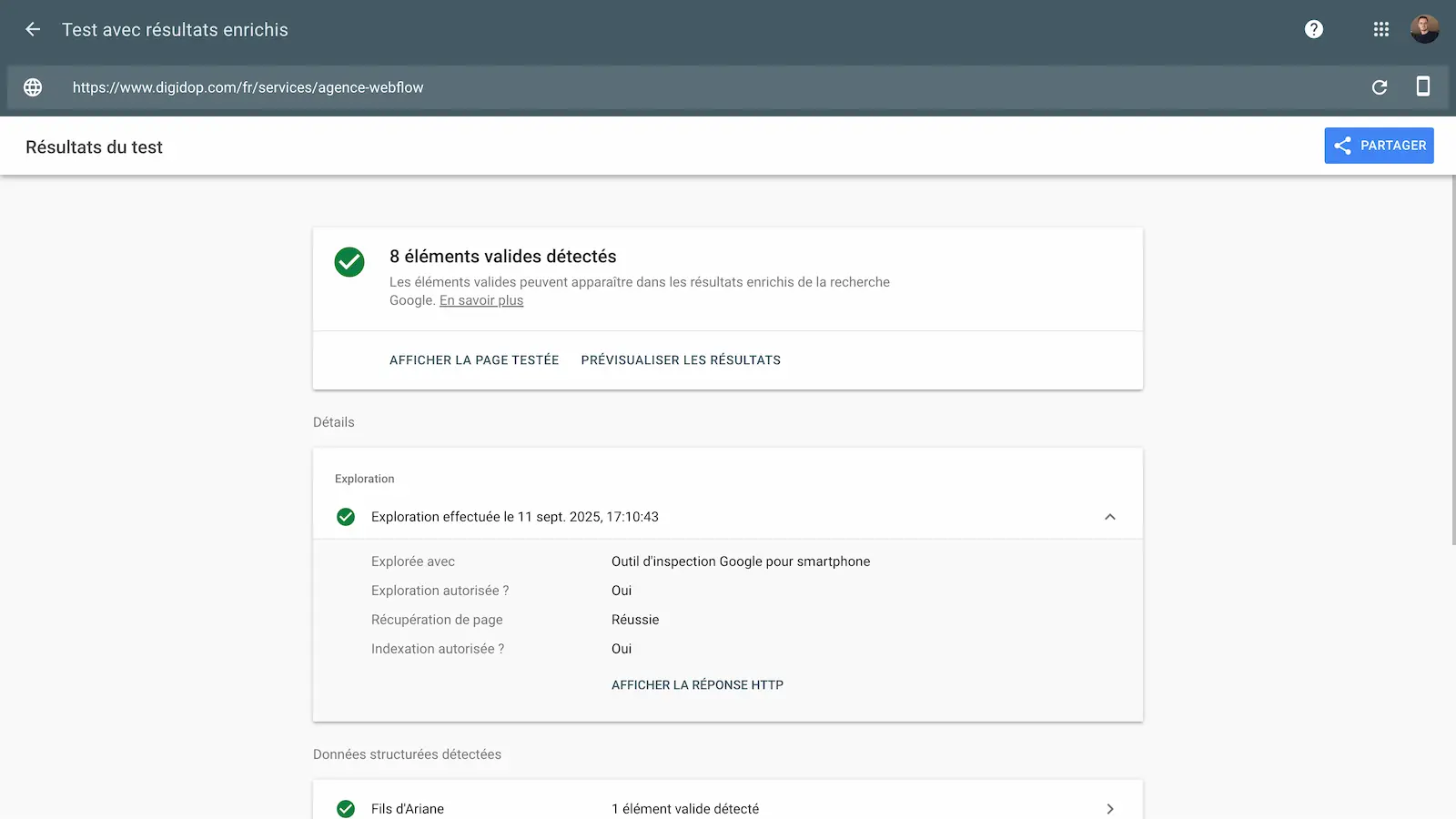
- Google's Rich Results Test tells you whether a page is eligible for a rich result, and which one.
- The Schema Markup Validator checks Schema.org syntax, including for types Google doesn't display (
Service, for example). - In Search Console, the Enhancements reports list errors by type, page by page.
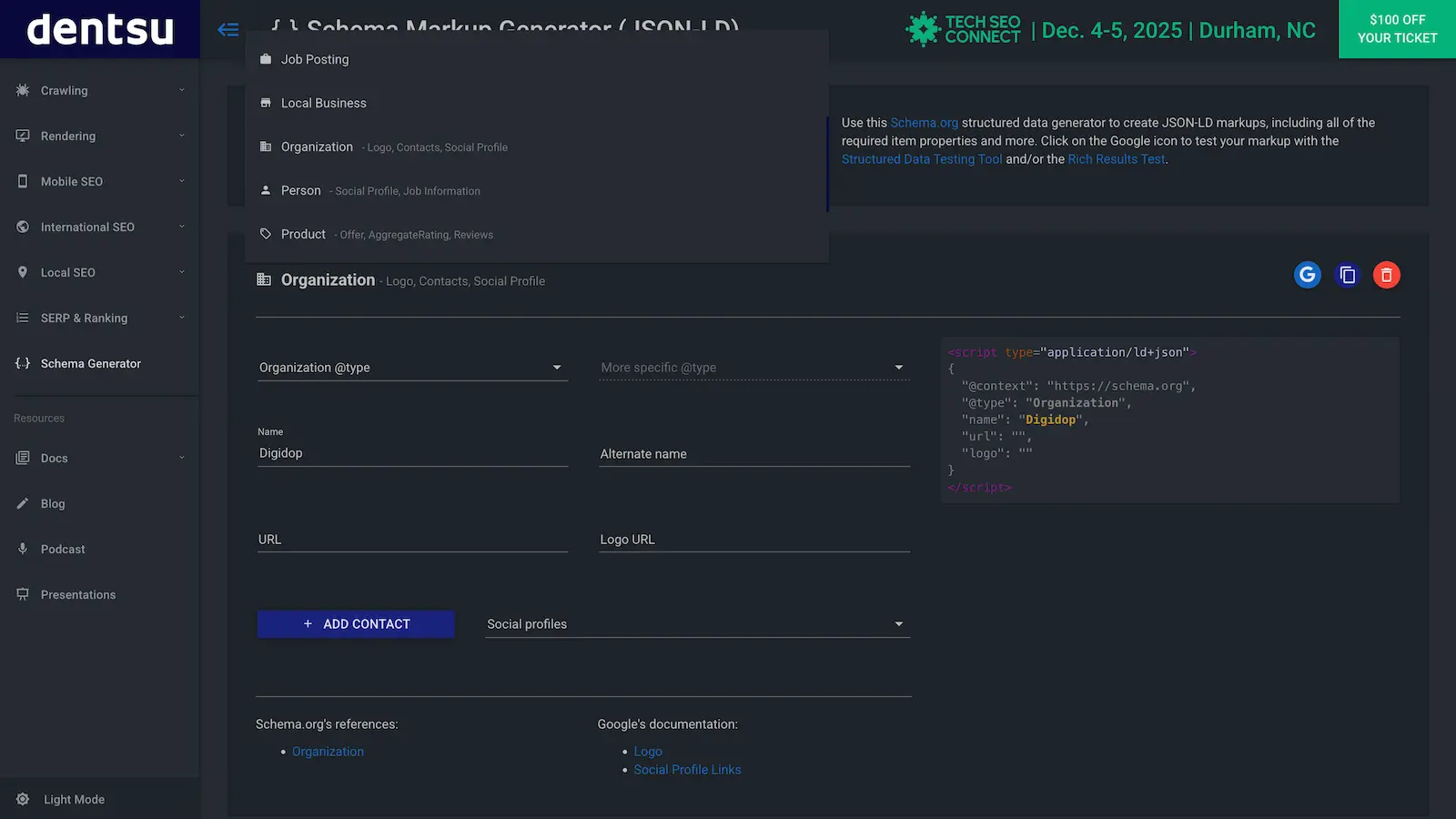
To write markup without starting from scratch, Dentsu's Schema Markup Generator is still handy, and the Schema.org documentation lists every property of every type.
Our take
Structured data is groundwork: you set it up once in your templates, then keep it current. On a Webflow site with a well-structured CMS, one template per Collection is enough, and it's something we build in on every Webflow site Digidop delivers.
The mistakes we see most come from overdoing it: FAQ markup added for stars that will never show, customer reviews marked up on your own home page, generated markup that's never updated when the content changes. Wrong markup does more harm than no markup.
For GEO, keep expectations realistic. A clean, consistent Organization markup helps engines know who you are. What gets you cited is still your content, and what others say about it.
{{custom-blog-cta}}
Frequently asked questions
Does structured data improve Google rankings?
Not rankings: Google doesn't treat it as a ranking factor. It makes a page eligible for rich results (stars, price, breadcrumbs, video), which can raise click-through rate, and it helps Google identify a page's author, publisher and topic.
Does structured data help you appear in ChatGPT or AI answers?
No vendor promises it. Google writes that no special markup is needed for its generative AI features. Microsoft says schema helps its systems, Copilot included, understand content. OpenAI only documents its use for products in ChatGPT shopping. Markup helps keep your identity consistent; it doesn't replace content worth citing.
Is FAQ markup still worth it?
Not for Google: the FAQ rich result hasn't been shown since May 7, 2026. No need to add it, and no need to remove existing markup. A visible FAQ on the page is still worth having for readers.
What structured data should a product page use?
Product, with an Offer (price, currency, availability) and, if you collect customer reviews of the product, AggregateRating. Google also documents return and shipping policies for merchants.
How do I test my structured data?
Use Google's Rich Results Test for eligibility and the Schema Markup Validator for syntax. Then monitor the Enhancements reports in Search Console.
Sources
- Google Search Central: introduction to structured data · general guidelines · rich results gallery
- Google Search Central: optimizing for generative AI features · documentation changelog
- Google: changes to HowTo and FAQ rich results (2023) · simplifying the search results page (2025)
- Microsoft Advertising: optimizing your content for inclusion in AI search answers
- Sequeda, Allemang, Jacob: a benchmark on knowledge graphs and LLM accuracy (arXiv)
- Webflow Help Center: add schema markup
- Schema.org